秘密
Sunak Vows ‘Radical’ Income Tax Cut as Truss Team Accuses Ex-Chancellor of ‘Another U-Turn’_我的网站

A | With a Tory leadership contest in full swing, former Chancellor Rishi Sunak has pledged to slash the basic rate of income tax by 20% by 2029 if he becomes UK prime minister, the largest such reduction in 30 years.,“What I’m putting to people today is a vision to deliver the biggest income tax cut since Margaret Thatcher’s government. It is a radical vision but also a realistic one, and there are some core principles that I’m simply not prepared to compromise on, whatever the prize,” Sunak emphasized.,Thatcher was Prime Minister of the UK from 1979 to 1990.,The ex-Chancellor also promised that if he prevails in the Tory leadership race, he will “never get taxes down in a way that just puts inflation up.” The 42-year-old added that he will “never make promises” he “can’t pay for” and he will “always be honest about the challenges” Britain faces.,Rishi Sunak Seeks to Crack Down on Foreign Lawbreakers, Increase Number of Deportations29 July, 09:11 GMT,“Because winning this leadership contest without levelling with people about what lies ahead would not only be dishonest – it would be an act of self-sabotage that condemns us to defeat at the next general election,” Sunak pointed out.,The Daily Mail cited an unnamed source from Foreign Secretary Liz Truss’s Tory leadership campaign as accusing Sunak of offering ‘jam tomorrow’.,“It’s welcome that Rishi has performed another U-turn on cutting tax, it’s only a shame he didn’t do this as chancellor when he repeatedly raised taxes. The public and Conservative Party members can see through these flip-flops,” the source argued.,This was echoed by Simon Clarke, chief secretary to the Treasury, who underscored that they “cannot afford to wait to help families, they need support now.” He made it clear that “Liz will cut taxes in seven weeks, not seven years.”,Sunak and Truss repeatedly locked horns over the tax issue during live TV debates last month, with the foreign secretary, in particular, accusing the former Chancellor of raising taxes “to the highest level in 70 years,” which is “not going to drive economic growth.”,Sunak claimed that the UK’s massive tax burden was the result of the unprecedented levels of government spending aimed at keeping the national economy afloat amid the coronavirus pandemic. Truss said that no other country was raising taxes, and accused Sunak of having no clear-cut plan for economic growth.,Meanwhile, voting ballots will start landing on doorsteps of Tory members starting Monday, with many of them expected to return the papers long before the September 2 deadline.,Sunak Unveils 10-Point Border Security Plan as Truss May Turn to Foreign Policy in Fight for PM Seat24 July, 06:12 GMT,Sunak and Truss are now two remaining candidates in the race to replace Boris Johnson as Conservative Party leader and prime minister. Both secured their places in the final two in July, when Trade Minister Penny Mordaunt was knocked out in the fifth round of voting by Conservative MPs.,The two contenders are set to spend the next few weeks campaigning for the votes of about 180,000 Conservative Party members around the country, who will vote by postal or online ballot. The winner of the party leadership race, who will be announced on September 5th, is due to automatically become UK prime minister.。

B |
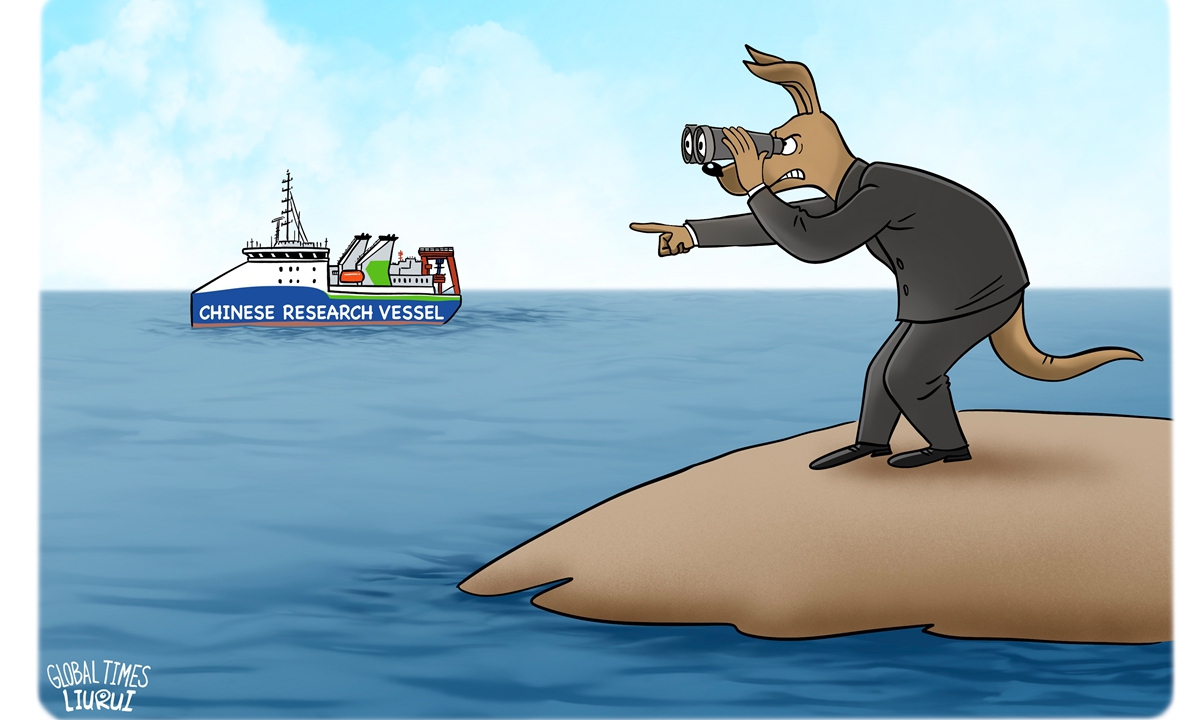
Illustration: Liu Rui/GTA new report funded by Australia's Department of Defense played up security risks to submarine cables in the Indo-Pacific waters and pointed finger at China and some other countries over alleged undersea‑cable attacks in recent years, while claiming threats against subsea cables are growing. A Chinese expert said that accusing China without conclusive evidence constitutes "over‑securitization" made by Australian side, as well as a calculated pretext for its own military expansion.
Published by the National Security College at the Australian National University (ANU), the paper claimed recent damage to cables in the Baltic Sea and around China's Taiwan region suggests "state actors are now actively probing and testing cable infrastructure in peacetime as part of broader hybrid warfare strategies" to rapidly degrade connectivity at the outset of a conflict, The Australian reported.
The paper claimed 16 privately owned subsea cables that carry 99 percent of Australia's internet traffic are a "high priority target" for Australia's adversaries that could be severed in a conflict, threatening the nation's economy and social fabric, according to The Australian.
The report singled out China and Russia for blame, saying that there have been multiple apparent attacks on submarine cables in recent years in European waters as well as near China's Taiwan region, suspected to be linked to Russia and China, the Straits Times reported.
However, the report cites a 2025 voyage by Chinese research vessel
Tan Suo Yi Hao along Australia's western and southern coastlines as evidence to back its claim that "potential adversaries are actively gathering information about Australia's cable infrastructure."
This report, relying on the routine scientific operations of a Chinese research vessel in 2025 to level allegations of offensive actions against China, and employing ambiguous terminology such as "suspected" and "potential," demonstrates Australia's evidentiary leap, Chen Hong, director of the Australian Studies Center of East China Normal University, told the Global Times on Monday.
This erroneous claim was refuted by the Chinese Foreign Ministry at the time. Chinese Foreign Ministry spokesperson Guo Jiakun said on March 31, 2025 that China carries out normal activities at sea in accordance with international law, including UNCLOS.
"We hope Australia will have a right understanding of this and stop the groundless suspicion and speculations," Guo added.
This is not the first time certain Australian politicians has leveled baseless accusations of China intending to sabotage its undersea cables. Back in May, Defense Minister Richard Marles claimed during the Shangri-La Dialogue that China ought to boost transparency around its maritime operations. He also asserted that a surge in damage to subsea cables had transformed the seabed into a "battlefield," per The Australian.
Chen said Australian side's scaremongering is tied to its predictive threat‑perception framework forged in recent years. This framework designates China and other countries as strategic competitors in advance, subsequently forces routine scientific activities into a confrontational framework, Chen said.
Apart from unfounded allegations against China, the paper claims Australia's defense military "must incorporate the defense of submarine cable infrastructure into its operational planning," according to The Australian.
It added the government should also consider up¬grading an auxiliary ship operated by the navy, ADV Guidance, to enable it to repair damaged cables.
The vast majority of submarine cable damages are caused by accidental factors such as fishing operations and vessel anchoring, rather than deliberate sabotage. For suspected cases of intentional damage, independent technical investigation bodies should be established, and the principle of "investigate first, characterize later" should be strictly applied, so as to prevent ordinary maritime accidents from escalating into diplomatic conflicts, Chen said.
The core problem of Australian side's submarine cable security lies entirely with itself. Instead of addressing its own infrastructure shortcomings and improving its domestic protection and maintenance systems, the Australian side has chosen to continually exaggerate external threats and stoke bloc confrontation, the expert added.
Chen said that by fabricating alleged Chinese threats, Australian side seeks to "rationalize" its military spending increases and underwater force expansion. The submarine digital infrastructure originally meant to serve global development has been labeled along us versus them lines, and this constitutes the biggest hidden danger, he added.
。

C |
Current article:http://www.jiaopeikongbenlo.pics/1p9hk/lduv.doc
Published on:07:10:57