
伪娘
Law restricting bathroom use for Idaho transgender students to go into effect as challenge continues_我的网站

A | BOISE, Idaho -- An Idaho law restricting which bathrooms transgender students can use in schools will go into effect while a court challenge plays out. Chief U.S. District Judge David Nye on Thursday denied a request by a plaintiff who is challenging the law to keep it from being enforced until the lawsuit is resolved, The Idaho Statesman reported. In August, Nye had placed the law on hold in August pending his decision.The law will go into effect 21 days after his ruling.It prohibits transgender students from using public school restrooms and locker rooms that align with their gender identity. It also allows other students to sue their school if they encounter a student using a bathroom that doesn’t align with their sex assigned at birth. Nye said the plaintiff failed to show their challenge would succeed. He noted the law is “substantially related to the government’s important interest in protecting the privacy and safety of students” while using a restroom or a changing room. Lambda Legal, which represents LGBTQ+ people in lawsuits, sued the state in July on behalf of an Idaho transgender student, arguing that the law known as Senate Bill 1100 unconstitutionally discriminates against students based on their gender identities.“Although it likely comes as little solace to Idaho’s transgender students who, as a result of the court’s decision today, may have to change their routines, or who, regrettably, may face other societal hardships, the court must stay within its lane,” Nye wrote. “Its duty is to interpret the law; it is not a policy-making body.” The judge also denied the state’s request to dismiss the case, saying state attorneys sought to dismiss all of the lawsuit's claims in a “perfunctory manner, with little explanation.”School districts in Idaho currently regulate which bathrooms transgender students may use. About a quarter of Idaho schools allow transgender students to use restrooms and locker rooms that align with their gender identity, Nye said in a previous decision.Thursday's ruling puts transgender students directly in harm's way by stigmatizing them as outsiders in their own communities and depriving them of the basic ability to go about their school day like everyone else, Peter Renn, Lambda Legal senior counsel, said in a statement."The vast majority of courts ruling on similar discriminatory laws have struck them down, and the court’s decision here is an outlier that fails to respect the equal dignity of transgender students,” he said.Idaho Superintendent for Public Instruction Debbie Critchfield, members of the Idaho State Board of Education and members of the Boise School District’s board of trustees are defendants in the case. Idaho Attorney General Raúl Labrador in a statement called the ruling a significant win for his office.“Society has separated these intimate facilities for time immemorial, and it is particularly important that the safety and privacy interests of minor students are protected,” Labrador said.Republican Sen. Ben Adams, of Nampa, sponsored the measure, and the Idaho Family Policy Center, a religious lobbying group, helped write it. The group also pushed a new Idaho law criminalizing gender-affirming health care for minors.Many GOP-controlled states have passed similar anti-transgender laws.In August, a federal appeals court upheld a decision blocking Idaho’s 2020 first-in-the-nation ban on transgender athletes in girls and women’s sports. In that case, a three-judge panel of the 9th U.S. Circuit Court of Appeals ruled that the ban discriminates against all women, citing a provision in the law that allows for anyone to dispute the sex of a female student athlete in Idaho. That provision would require the athlete to verify their gender through medical procedures, including gynecological exams.。
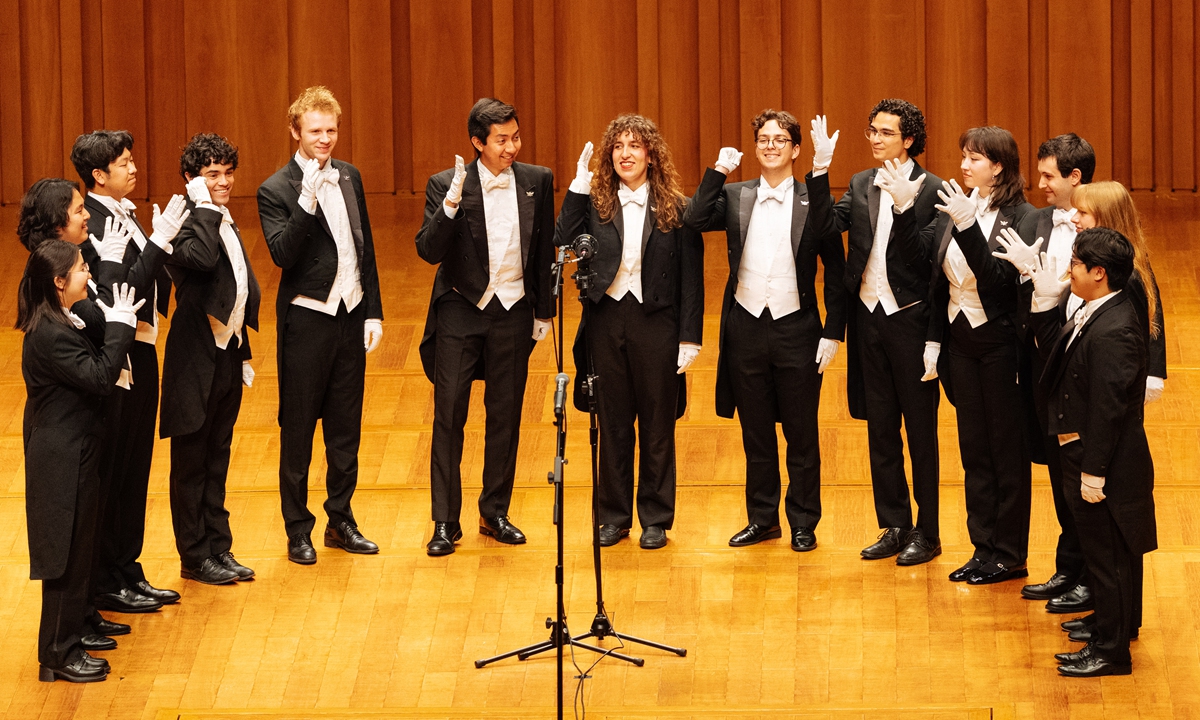
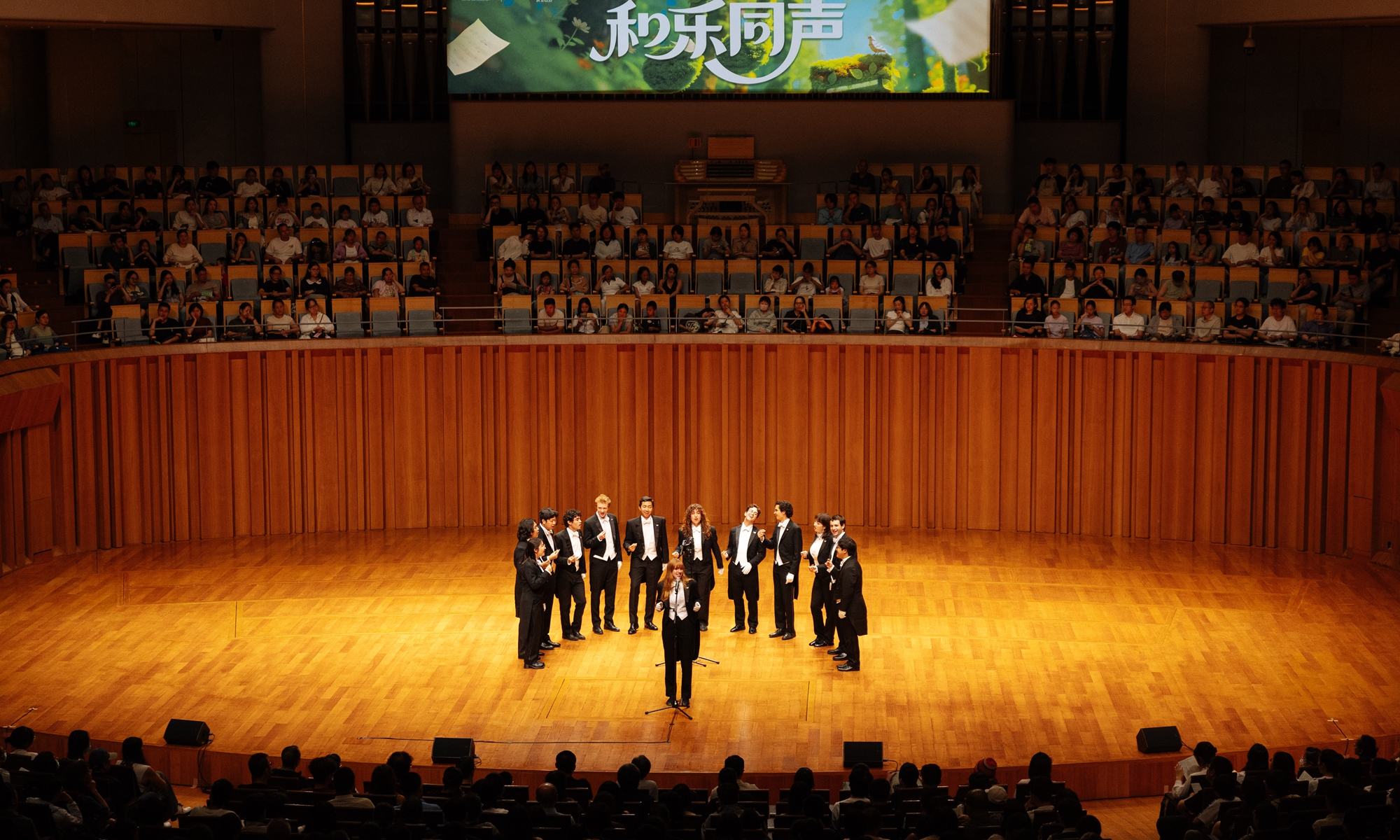
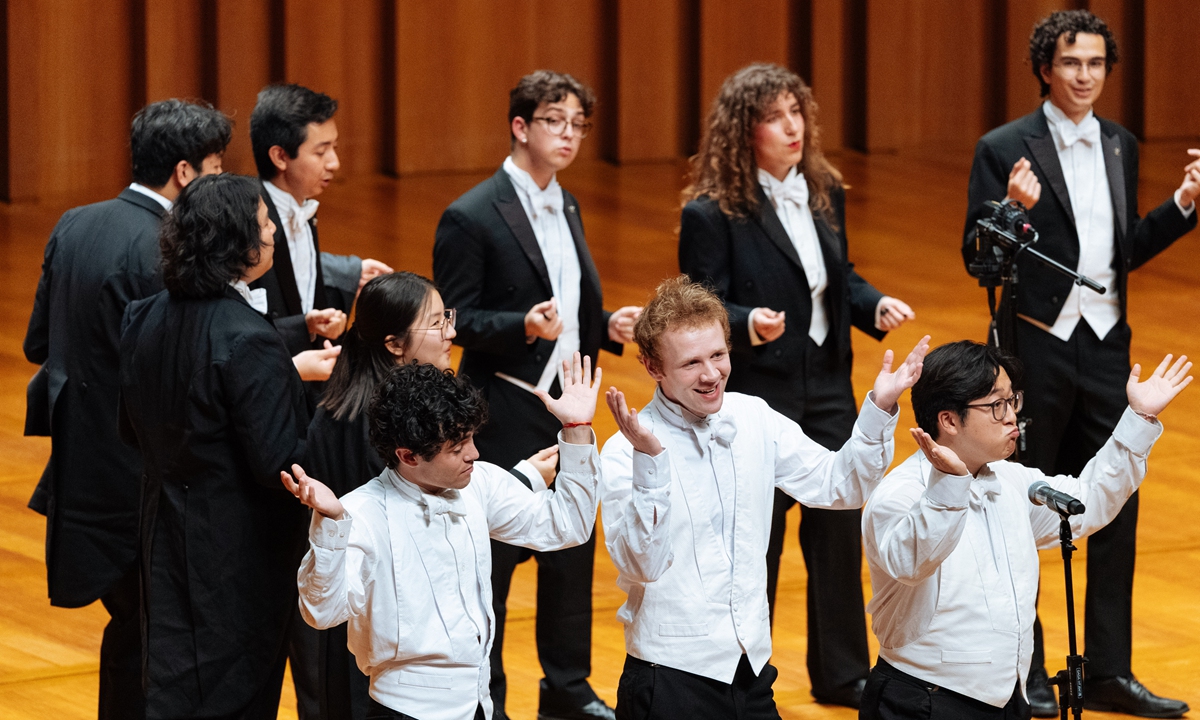
On the evening of August 12 at the National Centre for the Performing Arts in Beijing, the Yale Whiffenpoofs finished their scheduled program before returning to the stage for an encore featuring three Chinese songs: the traditional folk tune "Jasmine Flower," the popular hit "The Brightest Star in the Night Sky" and "Let the World Be Filled with Love."
The singers' carefully rehearsed Chinese was soon joined by voices from the auditorium, turning the encore into a chorus shared across the hall.
The moment brought a longer journey into focus. More than four decades after the Whiffenpoofs first toured China in 1985, the current ensemble spent 15 days traveling to nine destinations across the country in March and April before returning to Beijing in August.
Founded in 1909, the Whiffenpoofs are the oldest collegiate a cappella group in the US. Each year, 14 Yale students are selected for the student-run ensemble, which performs more than 200 concerts across six continents.
Over its 117-year history, the group has counted among its members songwriter and composer Cole Porter, former US senator Prescott Bush and actor Ron Livingston.
Most of the current members are not music majors. They study subjects ranging from history and global affairs to chemistry, biomedical engineering, neuroscience and economics, but set aside a year to place music at the center of their lives.
Across concert halls, university campuses and villages, the young singers encountered people and places that could not be reduced to distant headlines or images on a screen.
Their journey was not simply about mastering unfamiliar lyrics. It was also about what could begin once the singing stopped and conversation began.
For Zhang Yixiao, a 22-year-old Beijing native and the group's assistant musical director, one of those melodies carried a particularly personal memory.
Long before he left for Yale University, Zhang sang with the renowned Beijing Philharmonic Choir, founded by conductor Yang Hongnian. He also performed on the same stage during the annual August Chorus Festival.
"The Brightest Star in the Night Sky" was also a song he had grown up with - one that used to play over the loudspeakers while he and his classmates ran laps in middle school. Years later, he taught it to his American teammates and listened as a Beijing audience sang it back to them.
During the China tour, Zhang, who studies global affairs and economics at Yale, also helped his fellow singers cross a less familiar musical boundary. He selected the Chinese songs, explained their meanings and helped the group with pronunciation. The pieces were arranged by members of the ensemble.
He chose songs from different ends of China's musical landscape: "The Brightest Star in the Night Sky" represented a contemporary memory shared by many young Chinese people; "Jasmine Flower" introduced the group to one of the country's most recognizable traditional melodies.
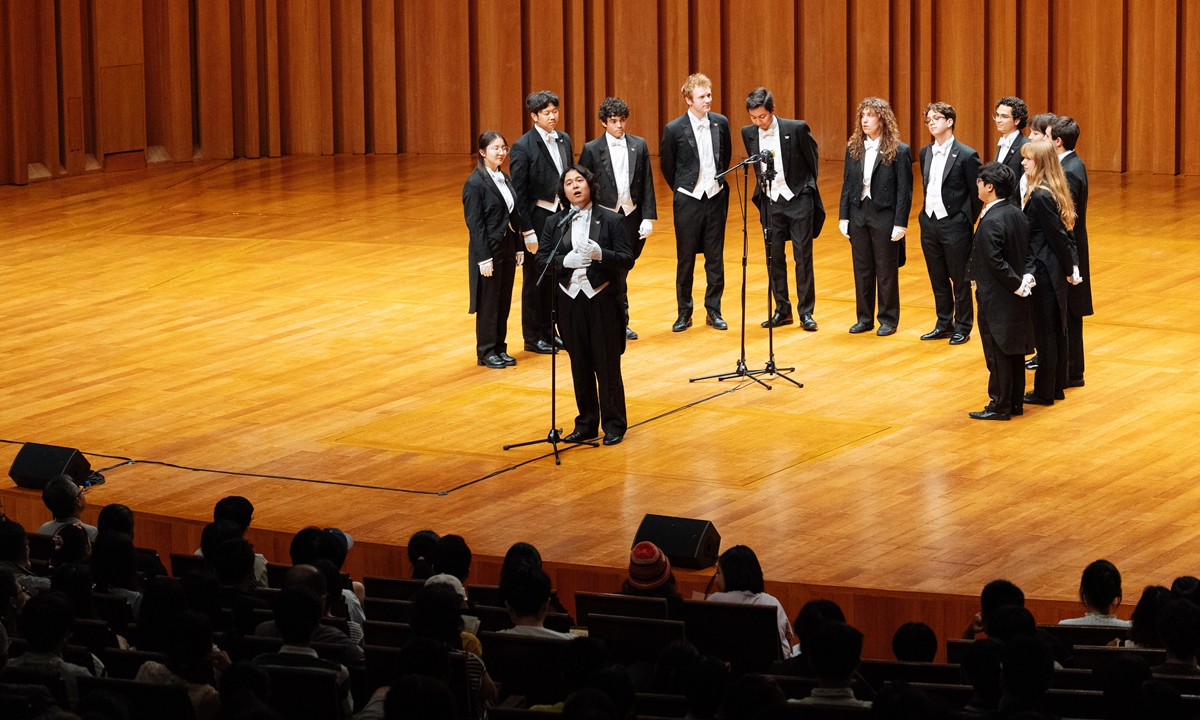
The work was shared by Eunice Oh, the first woman to serve as musical director in the Whiffenpoofs' history. Together, Oh and Zhang led the group through the process of learning the Chinese repertoire.
Hearing the Beijing audience join in gave that work an immediate payoff. "I really loved being able to sing with the audience," Oh told the Global Times. "It was very heartwarming."
Getting there required some work. "I think it's a little bit difficult, just because it's so different from the sounds we make in English," Oh said. Zhang taught the group not only how to pronounce the words but also what the lyrics meant. The process was nevertheless enjoyable, and "definitely worth the effort we put in," she said.
The response was often immediate. At performances across China, those in the audience who knew the words sang along.
"That was when we could feel the power of music transcending language divides," Zhang said. "No matter where we come from, or whether an ocean lies between us, we share a love of music and a love of life."
Other songs opened different conversations. After the group performed "Midnight Train to Georgia," a few people in the audience approached the singers to ask about a dance sequence in the number. The answer led to discussions of Hollywood and American popular culture. Chinese students, in turn, introduced Peking Opera and traditional instruments including the pipa, suona and guzheng.
The songs gave the two groups something concrete to ask each other about.
Echoes across time
The Whiffenpoofs' China tour this year was built around a piece of the group's own history.
In 1985, at the invitation of the Chinese People's Association for Friendship with Foreign Countries, the Whiffenpoofs made their first trip to China, performing in Beijing, Nanjing and Guangzhou. Parts of the journey were later preserved in the short documentary Perfect Harmony: The Whiffenpoofs in China.
They arrived in a country still in the early years of reform and opening-up, when even Coca-Cola was a novelty for many Chinese people, and so was the sight of a group of young American visitors.
The "Whiffs" climbed the Great Wall, spoke with Chinese university students, stopped to watch elderly residents practice tai chi, and sang in the open air at the Temple of Heaven.
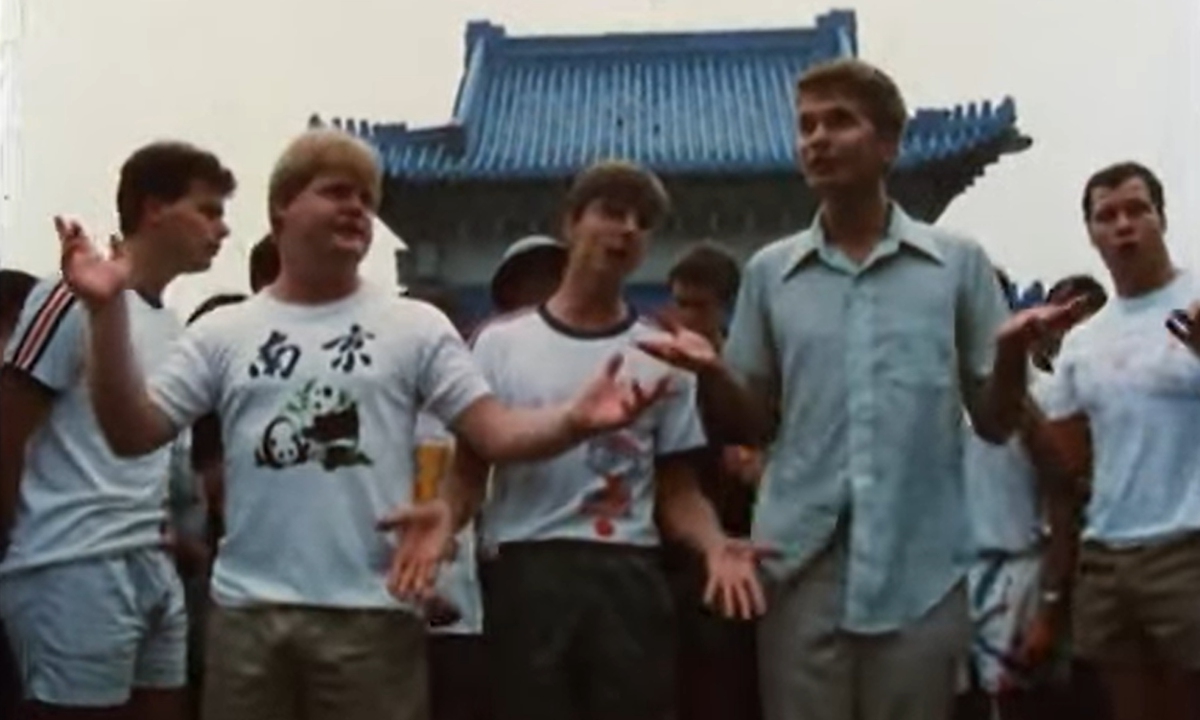
"Just as they had sung at the Temple of Heaven, we sang the same song again in the same place," Zhang said.
The reprise linked the two tours, while the rest of the itinerary showed how much more geographically varied the 2026 journey had become.
The new route extended well beyond major cities. In Zhaoxing Dong Village, Southwest China's Guizhou Province, the group performed with local choirs and listened to the Grand song of the Dong ethnic group, a polyphonic tradition performed without a conductor or instrumental accompaniment. The encounter brought together two distinct a cappella traditions.
Passed down orally within Dong communities, the tradition includes imitative songs that reproduce sounds from the natural world, particularly animal calls. It was inscribed on UNESCO's Representative List of the Intangible Cultural Heritage of Humanity in 2009.
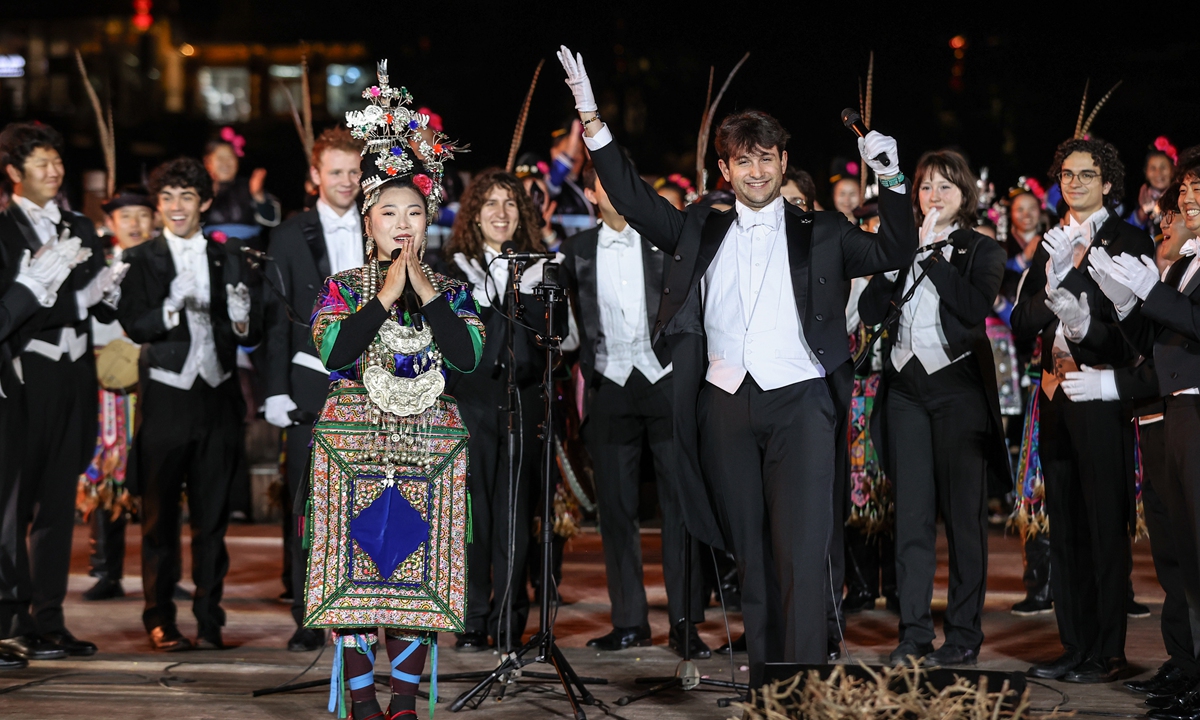
Zhang said stops such as Zhaoxing and Zhangjiajie gave his fellow singers a view of "a more diverse and different China."
The contrast between major cities and smaller villages became one of Oh's strongest impressions. "Being able to see the diversity that China has to offer, from these big cities to smaller villages, was incredible," Oh said. "I think it is a place unlike any other place I've been in my life and in my travels," she said.
Beyond the stage
Exchanges with Chinese students ran through both visits. During the March tour and the group's return to Beijing in August, the Whiffenpoofs visited universities, performed with student choirs and talked with peers close to their own age.
"Although we grew up in very different countries, the fact that we can all stand together and sing a song really brought us together," Oh said. "Music is a way to connect people."
Yet the connection did not end with the performance. Conversations with Chinese students gave the visitors access to the ordinary details of lives that rarely appear in international headlines.
"It's a very cool way to understand how people similar to our age have been experiencing their lives, and to share that with one another, and just learn about their culture and traditions and background in a way that is very different from just looking on social media or looking in a history textbook," Oh said.
Chinese students described the exchange in similarly concrete terms. Pan Lutong, a Nankai University student who performed with the Whiffenpoofs, said it was her first opportunity to work closely with a choir from an overseas university.
Outside rehearsals, the students also visited Tianjin's Ancient Culture Street together.
"This kind of exchange between students gave us a valuable friendship," Pan said.
The encounters continued in Beijing. On August 10, shortly after arriving in the city, the Whiffenpoofs rehearsed "The Brightest Star in the Night Sky" with the Beijing Wuzi University Riparian Choir.
"Through music, students from China and the US formed friendships and gained new cultural perspectives and musical experiences," a representative of the Riparian Choir told the Global Times.
The August 12 concert was the final performance of the group's year together. Two weeks later, Zhang said, the members would return to Yale, resume their studies and leave the road to another generation of Whiffenpoofs.
That work may continue after the tour. "This experience has shown me the importance and meaning of cultural exchange and face-to-face interaction," Zhang said. "I hope to continue working in this field in the future."
。
Current article:http://www.jiaopeikongbenlo.pics/i6e84/20260826/7031912.doc
Published on:16:25:29
- 2025年淘宝京东618活动持续到什么时候结束?京东618与国补叠加低至5折,买手机攻略
- China-CEEC cooperation opening doors
- 杭州市举办职工AI+金融行业研究大赛
- 长春加强师德师风建设,在职中小学教师有偿补课或被撤销教师资格_吉林省_给予
- 下周4只新股申购 A股年内已有7只“大肉签” 单签盈利均超10万
- 特斯拉Q3财报电话会议摘要:正在开发新电动汽车 成本只有Model 3一半
- 新政府重拳打击犯罪,囚犯将大幅增加,但监狱里住不下了……
- 小米春节今天继续:小米8手机2099元,学生6免息
- Rivian聘请前Waymo高管负责新自动驾驶和人工智能业务
- 台风“白海豚”已移出浙江,进入江西上饶!未来三天浙江暴雨、大暴雨“车轮战”,还要下一周